
1930
In the beginning they were just simple cards to track moving parts on the assembly lines. But over the years it became a blueprint for the shipping labels worldwide, even to this day. As you can see on the pictures above, the label has changed very little. The only major difference?
Bar- and qr-codes.

1940-1945
A little in contrast to WWI, the second World War was also the direct precursor of the Third Industrial Revolution, that officially would start a couple of years later.
Several computers like British 'Collosus', German Enigma's, Zue 1-3 later, machine's are starting to significantly shrink in size and double in capability, consistent with Moore's Law. The world is 'computation' from now on.


1947-1995 Industrial Revolution #III
During these six decades various publications on milestone insights, flowing out of Kanban, hit our system dynamics. Next to Toyota's ‘Just In Time’ philosophy many other like it begin to redefine the business landscapes. Software engineering and interdisciplinary, large scale operations such as space exploration, harnessing nuclear power, … It all clearly needed some new approaches. In short, this, Third Industrial Revolution created the basic mindset for the Agile environment we all know, love and cherish today.
At this moment in time,
boundaries
to the newest technologies
are not clear at all,
possibilities seem endless.
Armed with these new technologies
we take a major 'Leap of Faith' forward
with the future at our feet...
 |  |  |
|---|---|---|
 |  |  |
 |  |  |
 |
1960-1995
These are some of the most important business innovations and software development techniques developed during those decades, preceding, seeding, Industrial Revolution #4:
click below to
enlarge
a short introduction
More detailed reads :
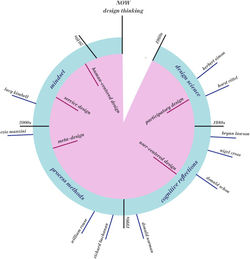
1960 - Design Thinking (DT), origins of modern day business approaches, various contributors.
1970 - Dynamic Duo software programming (DD), various contributors, predecessor Pair programing
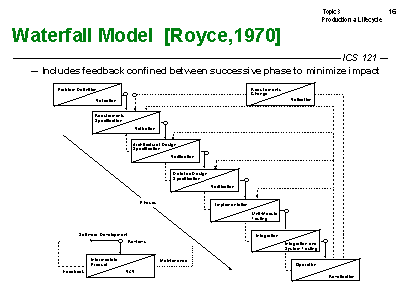
1970 - Waterfall (SDLC), Winston Royce’s paper on software development, published.
1975 - The Mythical Man-Month & Brooks's Law Dillema's (Ned.), predecessor Adaptive software development.
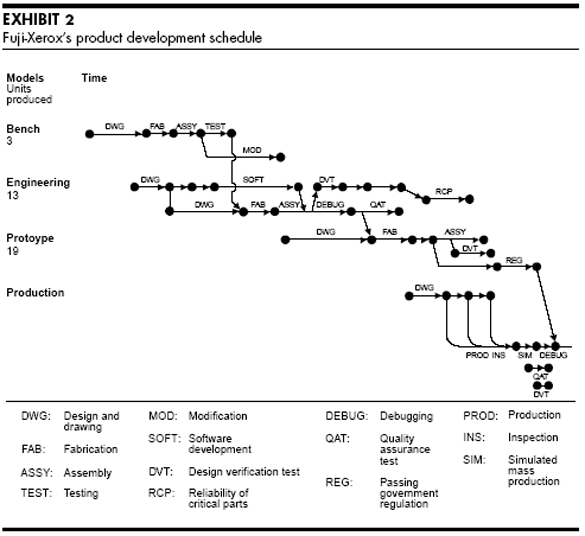
1986 - The New New Product Game Development Game, by profs. Takeuchi and Nonaka, published.
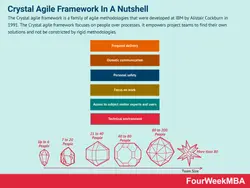
1992 - Crystal Methodologies (CRYSTAL), by I.B.M software development, predecessor AGILE Manifesto.
1991 - Rapid Application Development (RAD), published.
1994 - Continuous Integration (CI), at NASA, predecessor Extreme Programming.
1995 - Pair Programming (PP), iterating roles observer/navigator
1995 - Dynamic Systems Development Method (DSDM), framework, published.
1995
Another major change, due to the start of the Fourth Industrial Revolution, came into being:
The first public appearance of Scrum at OOPSLA was undoubtedly an important moment in Scrum history— yet the framework was far from complete. In fact, back then, Scrum was most commonly referred to as a “process,” offering a far more prescriptive view when it came to things like team size and techniques.
At its core, however, the paper advanced a spirit of innovation and change, foreshadowing the many ways it would transform project management for years to come.
read: Scrum, the Early Years