
Kanban read : simple Glossary
It was, again, the automotive industry, more specifically Toyota car company that would lay another solid foundation for, give or take, the coming century. The word itself, Kanban means “billboard” or “signboard” in Japanese.
It started as a way of tracking the parts used on a conveyor belt production line and was so effective it evolved into the 'Just-In-Time' delivery system which is still an essential part of business today. Even to companies that only deal in virtual products. Overall, Kanban is a way of visualizing any task and/or progress of workflow. It is simple, easy to understand and the board can be customized to specific needs. Example guides can be found below.
Four Basic Principles of Kanban
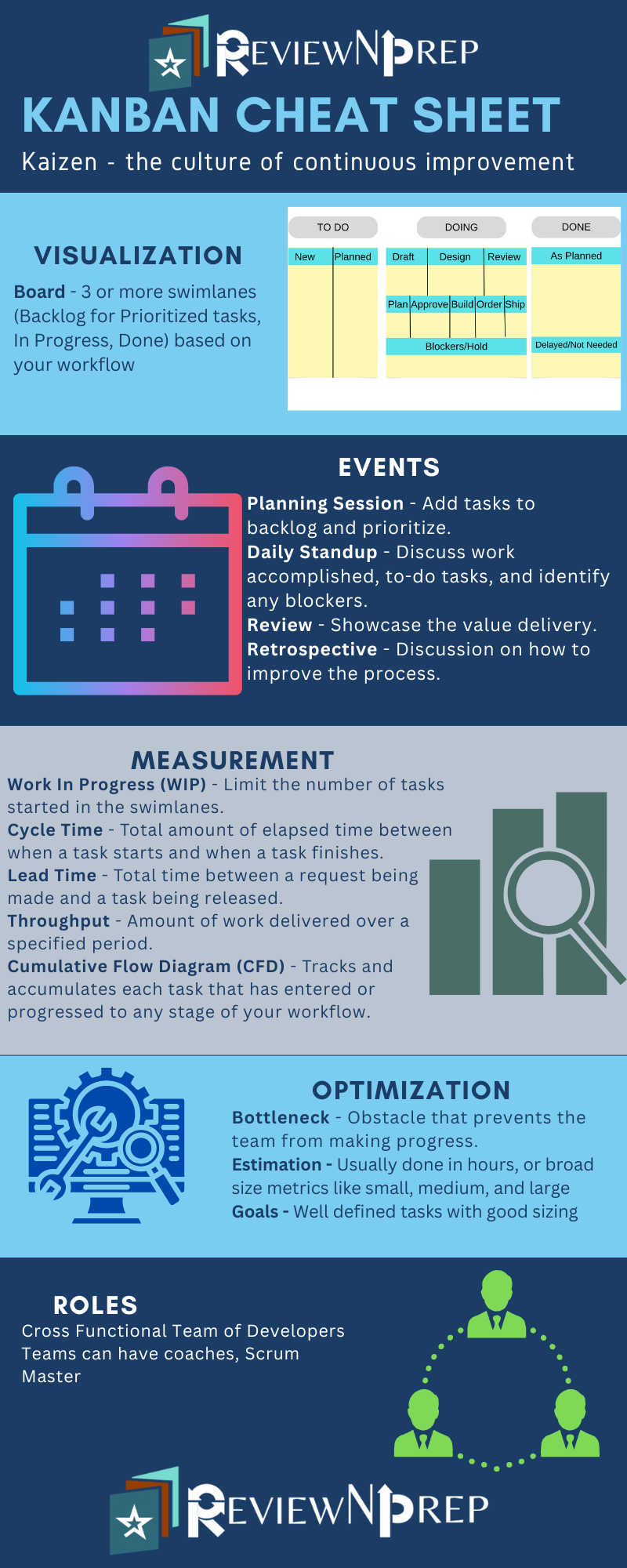
see : Infographic1
Four basic principles have emerged through the evolution of Kanban in knowledge-based industry.
-
Start with what you do now. You do not have to start from scratch to apply the Kanban process. Kanban, with its focus on WIP (Work In Progress), can be easily overlaid onto your current project and processes.
-
Agree to pursue incremental, evolutionary change. Kanban is incremental by nature and, therefore, focuses on making small, continuous changes to current processes that can be easily tracked. Major overhauls of processes are discouraged, as users tend to resist large-scale changes.
-
Respect the current process, roles, responsibilities, and titles. Kanban recognizes that your current processes have value and doesn’t mandate changes to existing processes. Rather, Kanban introduces small, incremental alterations into your current processes to contribute to the overarching goal of continuous improvement. Your team will respond more readily to small adjustments rather than wide-sweeping changes.
-
Encourage acts of leadership at all levels. In Kanban, leadership is not relegated to a designated few. Rather, the entire team is responsible for fostering Kaizen, meaning 'good' and 'change' — a mindset of continuous improvement leading to workflow optimization in a process that all team members can contribute to and embrace.


The Six General Practices of Kanban
In addition to the aforementioned four principles, the Kanban process embraces six practices:
-
Visualize workflow. Seeing work progress across the Kanban board is key to optimizing workflow and revealing bottlenecks in the pipeline. When team members can easily identify a problem, they can take specific steps to resolve the issues and put workflow back on track.
-
Limit work in progress (WIP). The WIP column plays a central role in the Kanban process. Restricting WIP forces the team to focus on a finite number of tasks and drive work to completion.
-
Manage flow. Consistently tracking and analyzing cycle times and other agreed-upon metrics leads to an ever-evolving process of fine-tuning and streamlining processes to improve workflow and forecast delivery.
-
Make policies explicit. Kanban teams need to establish basic rules specific to their process, including when to move a work item to the next state, how to post WIP limits, how to flag impediments, and how to organize and maintain the board. Team members should also understand and buy into both the overall Kanban process and their own team’s guidelines and goals.
-
Implement feedback loops. Scheduling Scrum-style standups, reviews, and retrospective meetings can help in assessing what worked, what didn’t, and what to improve for each project cycle. This holds especially true for new teams.
-
Collaborate for improvement, evolve experimentally. With no set due dates, work in progress becomes the focus in Kanban, with continuous improvement and delivery as the goal. As team members collaborate to troubleshoot problems and brainstorm new ideas, the process becomes more efficient and streamlined, thus optimizing workflow.
Jim Benson, Owner of Modus Cooperandi and Creator of Personal Kanban, boils down the Kanban process further into two simple rules: visualize your work and limit your work in progress.



The Pitfalls of Kanban?
Kanban is most effective when team collaboration is strong and team members are fully engaged with the Kanban board and process. Problems can arise when team members do not understand or are not fully involved with the process. But this is true not only in this case. This counts for every system dynamic implemented anywhere, anytime.
-
WIP Limits: WIP limits are a key feature of Kanban, and it won’t work if you don’t implement them. Your team needs to establish limits that are reasonable and stick to them, even under pressure from managers and customers, in order to keep work flowing smoothly. If in-progress work exceeds established limits or if limits are set too high, members may experience overload, putting workflow and delivery at risk. Problems may also arise if a team member veers off to work on a lower-priority task before finishing the one they pulled from the To Do column. It is essential that team members complete high-priority tasks first before moving on to the next.
-
Board Maintenance: A well-maintained Kanban board visually communicates workflow progress and impediments at a glance. Simplicity is key with Kanban; if a board is too cluttered or confusing, or it is not updated regularly to reflect the most current work status, workflow will falter. If team members have trouble figuring out where to place a card or are not able to track workflow status, it may be a good idea to discuss how to restructure and simplify the board.
-
Collaboration and Communication: Each member needs to take responsibility for the team’s success for the Kanban process to work. This includes being on board with established WIP limits and being willing to “swarm” in to help a colleague if a task is on the line. On the other hand, a team member who tries to own a piece of the process and not allow others to help can jeopardize everyone’s productivity. A lack of collaboration and communication between team members threatens the Kanban process and sabotages trust. If communication is failing, the team may want to add daily stand-up meetings, reviews, and/or retrospective meetings to their Kanban process.
-
Removing the Knowledge from Knowledge Work: The purpose of using Kanban is to improve process management on the whole, not for a team to devolve into several highly specialized but disconnected functions. When people using a Kanban board overspecialize — that is, when they work exclusively on certain types of tasks — information silos pop up.
In conclusion : -
The team can lose sight of the overall objective because it’s focused too heavily on individual milestones. This is especially dangerous when work items on the Kanban board are meant to integrate with each other. So be on your guard the project does not turn into a traditional linear Waterfall structure, the major pitfall to avoid.