
1995 - 2010
Industrial Revolution # IV
What technologies are behind the change? by SalesForce
The easiest way to understand the Fourth Industrial Revolution is to focus on the technologies driving it. These include the following:
Artificial intelligence (AI)
AI describes computers that can “think” like humans. They can recognize complex patterns, process information, draw conclusions, and make recommendations. AI is used in many ways, from spotting patterns in huge piles of unstructured data to powering the autocorrect on your phone.
Web3
Web3 is the third iteration of the internet. Web1 allowed people to access and read information on websites, like Yahoo. In Web2, blogs, wikis, and social media like Twitter and YouTube got introduced, giving people more control over the information they created and shared. In Web3, the decentralized world puts ownership into the hands of the community. Web3 comprises blockchain technology, cryptocurrencies, and token-based economics, like NFTs.
Blockchain
Blockchain is a secure, decentralized, and transparent way of recording and sharing data, with no need to rely on third-party intermediaries. The digital currency Bitcoin is the best known blockchain application. However, the technology can be used in other ways, including making supply chains traceable, securing sensitive medical data anonymously, and combating voter fraud.
Faster computer processing
New computational technologies are making computers smarter. They enable computers to process vast amounts of data faster than ever before, while the advent of the cloud has allowed businesses to safely store and access their information from anywhere with internet access. Quantum computing technologies now in development will eventually make computers millions of times more powerful. These computers will have the potential to supercharge AI, create highly complex data models in seconds, and speed up the discovery of new materials.
Virtual reality (VR) and augmented reality (AR)
What’s the difference? VR offers immersive digital experiences (using a VR headset) that simulate the real world, while augmented reality (AR) merges the digital and physical worlds. Examples include L’Oréal’s AI-powered virtual try-on tool, which allows users to digitally experiment with makeup products before buying them, and the Google Translate phone app, which allows users to scan and instantly translate street signs, menus, and other text.
Biotechnology
Biotechnology harnesses cellular and biomolecular processes to develop new technologies and products for a range of uses, including developing new pharmaceuticals and materials, more efficient industrial manufacturing processes, and cleaner, more efficient energy sources. Researchers in Stockholm, for example, are working on what is being touted as the strongest biomaterial ever produced.
Robotics
Robotics refers to the design, manufacture, and use of robots for personal and commercial use. While we’re yet to see robot assistants in every home, technological advances have made robots increasingly complex and sophisticated. They are used in fields as wide-ranging as manufacturing, health and safety, and human assistance.
The Internet of Things
The IoT describes everyday items — from medical wearables that monitor users’ physical condition, to cars and tracking devices inserted into parcels — connected to the internet and identifiable by other devices. A big plus for businesses is they can collect customer data from constantly connected products, allowing them to better gauge how customers use products and tailor marketing campaigns accordingly. There are also many industrial applications, such as farmers putting IoT sensors into fields to monitor soil attributes and inform decisions such as when to fertilize.
3D printing
3D printing allows manufacturing businesses to print their own parts, with less tooling, at a lower cost, and faster than via traditional processes. Plus, designs can be customized to ensure a perfect fit.
And more
Innovative materials — including plastics, metal alloys, and biomaterials — promise to shake up sectors including manufacturing, renewable energy, construction, and healthcare. Energy capture, storage, and transmission represent a growing market sector, spurred by the falling cost of renewable energy technologies and improvements in battery storage capacity.
Needless to say, the development of these new industries, more and more computer driven then ever, required new methods of project management.
15 years of Scrum and Software development gave us these methods:
 |  |  |  |
|---|---|---|---|
 |  |  |  |
 |  |  |
1995 - SCRUM, not an acronym but derived from the ‘crowd’, presented at OOPSLA conference.
1996 - Extreme Programming (XP), developed on Chrysler’s Payroll Compensation C3 project.
1996 - Scrum Of Scrums (SoS), predecessor Large Scale Scrum and Scrumban.
1996 - Continuous Delivery (CD), predecessor
1997 - Feature Driven Development (FDD) processes designed by Jeff De Luca.
1999 - Adaptive Software Development (ASD), published.
2001 - Crystal Light methodologies (CLEAR), described in Cutter IT Journal.
2001 - Agile Manifesto, by Agile Alliance, published.
2002 - Test Driven Development (TDD), by Kent Beck, ex-Chrysler.
2003 - LEAN software Development, toolkit software projects, predecessor disciplined Agile.
2004 - Agile Project Managment (AgilePM), Agile goes mainstream, various contributors.
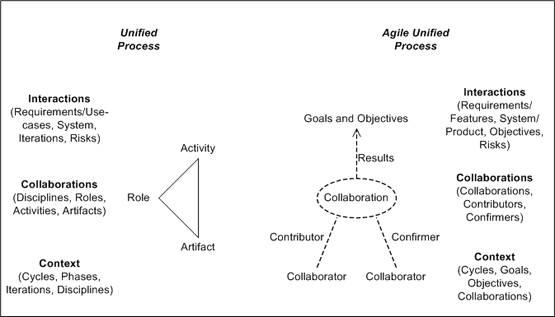
2005 - Agile Unified Process (AUP), refinement of some of the above, predecessor Disciplined Agile.
2005 - Large Scale SCRUM (LeSS), by Agile Alliance, published.
2006 - Disciplined Agile (DAD)
2006 - Scrum at Scale (S@S), extends core Scrum framework, same authors Scrum.
2006 - Open Unified Process (OpenUP), origin open source process content I.B.M.
2007 - Kanban Software Development (WIP)
2009 - ScrumBan, hybrids of SCRUM and Kanban by Agile Alliance.
2009 - Development and Operations (DevOps), predecessor Nexus, conference.
2010 - Adaptive Project Framework (APF)
Wave after wave, a cascade of innovations within business organization in general. The sum of these frameworks are what we call today: Agile and Lean, a modern mindset that will set the stage for Industrial Revolution #V.